resources
PODCAST
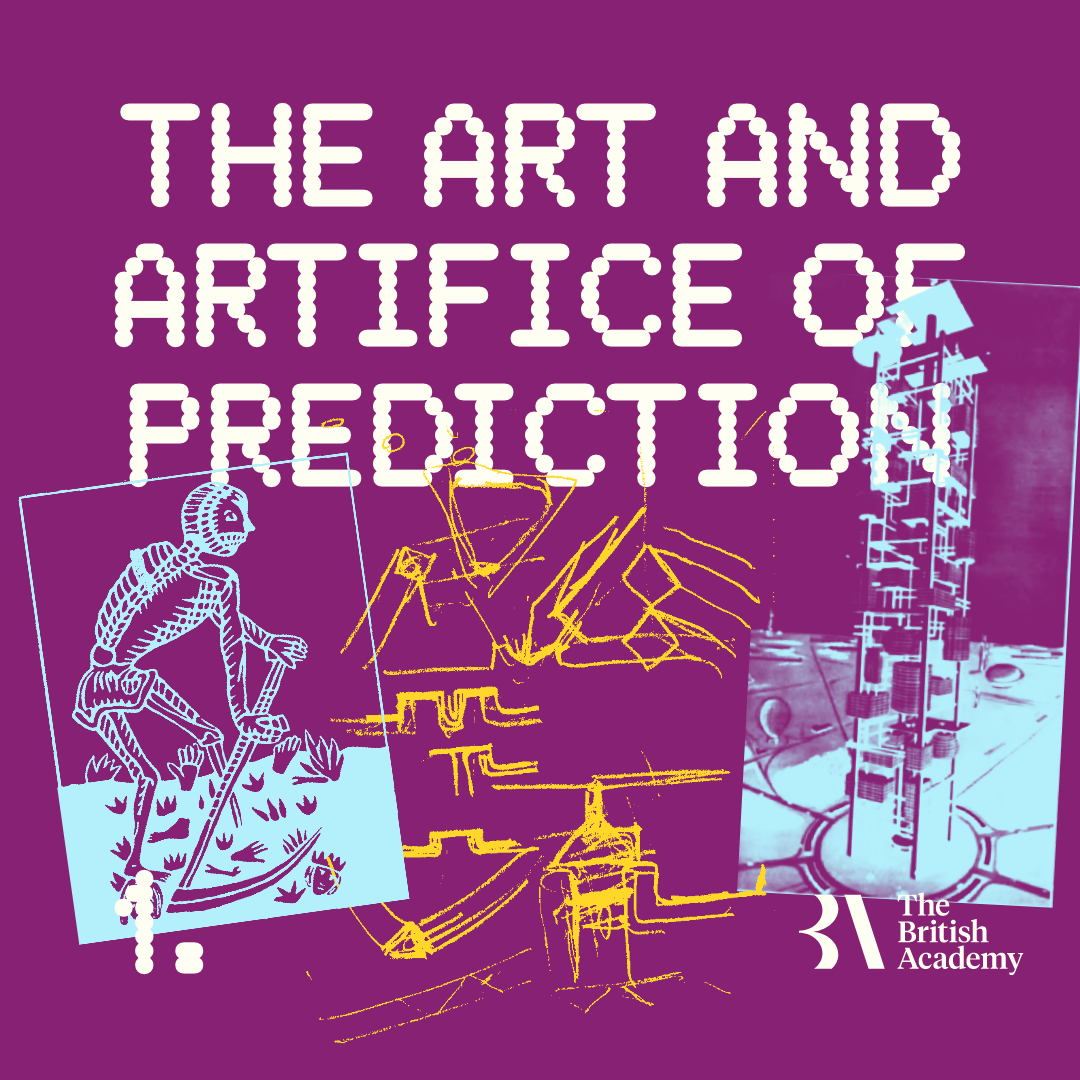
The art and artifice of prediction
The podcasts consider the role of geopolitical anxieties, technology, institutions, the arts, and the environmental movement in shaping the appetite for prediction and in the proliferation of different visions of the future.
The series is presented by Maria Christou (University of Manchester), Lise Butler (City St. George’s, University of London), and Ruth Morgan (Australian National University) and Dan McAteer (University of Oxford). Episodes were produced by Atina Dimitrova.
EPISODES
Episode 1.
The Rise of Future Studies and Futurology During the Cold War
Lise Butler speaks to the historian Jenny Andersson about the rise of future studies and futurology during the Cold War.
LISTEN HERE

Episode 2.
Social Science and the American Defence Establishment
Lise Butler speaks to Daniel Bessner about the close relationship between social science and the American defence establishment in the mid-twentieth century, and the use of predictive methods, like the American RAND corporation’s Delphi system, in Cold War era foreign policy.
LISTEN HERE
Episode 3.
The Rise and Fall of World Systems Modelling in the 1960s and 1970s
Ruth Morgan speaks to historian and writer Sarah Dry about the Club of Rome's Limits to Growth report (1972) and the rise and fall of world systems modelling in the 1960s and 1970s.
LISTEN HERE
Episode 4.
The Rise of Climate Modelling and the Quantification of Climate Futures
Ruth Morgan speaks to historian Matthias Heymann about the rise of climate modelling and the quantification of climate futures. How did these techniques affect the ways we understand the climate and the effects of climate change?
LISTEN HERE
Episode 5.
Prediction and Anthropocene Fiction
Maria Christou speaks to Patrick Whitmarsh about predicting the future in science fiction and speculative fiction, and the ways in which these genres conceptualise our future extinction.
LISTEN HERE
Episode 6.
The Infrastructures of Prediction and Visual Culture
Maria Christou talks to Theo Reeves-Evison about how the ‘infrastructures of prediction' are responded to and initiated by visual culture.
LISTEN HERE
Episode 7.
Cybernetics and Cybernation Theorists
Daniel McAteer speaks to Andrew Sanchez about the cybernation theorists of the 1960s. What kind of society did cybernation envision? And how can past ideas about automation inform contemporary debates?
LISTEN HERE
ARTICLES
Lise Butler, Jane Elliott, and Jon Lawrence, ‘Writing for Influence: Social Scientists, New Society, and the Politics of Social Change’, in Gary Love and Richard Toye ed. Writing Politics in Modern Britain: Genres and Cultures of Publishing Since 1900 (Cambridge: Cambridge University Press, 2026)
LINK
From the 1960s to the 1980s British social scientists used popular writing to influence public debate. One important forum for this was the popular social science weekly New Society. This article examines how three social scientists – the urbanist Peter Hall, and the sociologists Ann Oakley and Ray Pahl – used New Society to reach a wider audience and shape policy. Future prediction and forecasting were central to these social scientists’ writings: Hall’s articles speculated about the future land use planning and urban environments, while Pahl’s writings anticipated post-work futures predicated on deindustrialisation and widespread job loss. In exploring how social scientists wrote for a wider public, this chapter shows how New Society provided a platform for social scientists to describe and speculate about the consequences of economic and social change.
Or Rosenboim; “What Is “Planetary” Politics?”. Global Perspectives 10 March 2025; 6 (1): 146446. doi: LINK
Is “planetary” a useful concept for political thought? What is the historical trajectory of this idea? The essay reflects on recent literature on planetary and global thinking to consider the challenges that this idea raises for predicting the future of political relations beyond the state up to the world scale. By drawing on grassroots histories of mobility and the role of food as a bridge between human and nonhuman environments, the essay offers a reflection on the history of uses of the “planetary” to predict the possibilities of ordering human “messiness” and political multiplicity.
Or Rosenboim, “Global Divisions: The spatial imagination of Barbara Ward”, accepted for publication in Global Studies Quarterly, 2025.
The article examines the international thought of the British economist Barbara Ward (1914-1981) through her spatial imagination It argues that Ward used categories such East, West, North and South to discuss existing cleavages in world political and economic affairs. Through an examination of Ward’s political thought from the late 1930s to the late 1960s, the article shows how these spatial imaginaries were influenced by imperial and civilizational hierarchies. Moreover, the article shows how these divisions were, for her, a rhetorical tool to advance her vision of world unity, discussed through the notions of ‘spaceship earth’ and ‘planetary community’. In her discussions of economic growth and equality, Ward emphasised the importance of spirituality and ideas. The article thus shows that she identified the spiritual foundation of this new global order with a particular religious creed, Christianity, which for her provided a unifying universal morality. Ward’s work demonstrates both the promises and profound contradictions of global visions rooted in Western-centric moral frameworks. Her legacy invites critical reflection on how efforts to imagine the future of planetary solidarity can unwittingly reproduce the very inequalities they aim to overcome.
Ben Moore, Invisible Architecture in Nineteenth-Century Literature: Rethinking Urban Modernity (Edinburgh University press, 2024. LINK
This book rethinks the relationship between architecture, literature and (in)visibility in the nineteenth-century city, considering the role of prediction and planning in the urban imagination.
Winner of the 2025 ASCA Book Award